Wednesday, December 14, 2005


Global Spec Confirms what we all know is true.

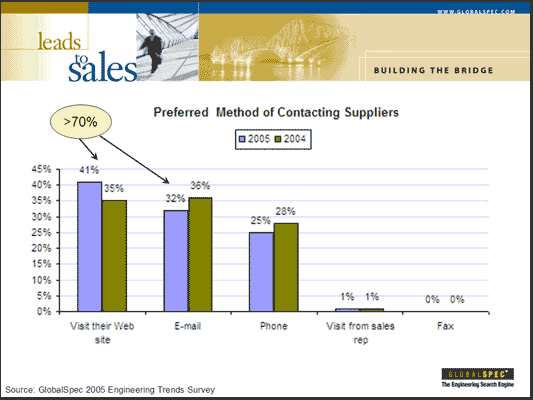
From the GlobalSpec's 2005 seminar series, "Leads to Sales: Building the Bridge," they presented facts about a supplier's technical audience, including: more than 70% of engineers and technical professionals state their preferred way to contact suppliers is through e-mail or supplier Web sites.
Pheedo Study: Stand-Alone RSS Ads See Higher Click-Throughs - 12/14/2005
"CONSUMERS USING RSS READERS ARE more likely to click on ads presented as stand-alone posts than on ads within posts--7.99 percent to 0.85 percent--according to research conducted this fall by RSS company Pheedo and set for release today. "

The report also notes readership rises at the beginning of the week--peaks on Wednesday then declines. Avg weekend readership is 70 percent lower than weekdays. Bloglines is also the RSS reader of choice.
Search Use Continues To Grow:
"by Gavin O'Malley, Wednesday, Dec 14, 2005 6:00 AM EST

WEB USERS CONDUCTED MORE THAN 5.1 billion search queries in October--marking a 15 percent increase from June, according to a Nielsen//NetRatings report released Tuesday.

Google maintained its leadership position, garnering 2.4 billion search requests, or almost half--48 percent--of all searches. Yahoo! accounted for 21.8 percent of all searches, followed by Microsoft's MSN, which was responsible for 11.3 percent of search activity.
Time Warner's AOL was in fourth place, with 358,667 searches, or 7.2 percent of search activity. Currently, Google powers AOL's search engine and receives revenue from the company. But, with Time Warner considering a range of options for AOL--ranging from spinning off the company to doing some sort of joint venture with either Google or Microsoft--that deal might not continue for long.

If Microsoft starts powering AOL's search engine, and AOL continues to account for the same proportion of search activity as at present, MSN would have nearly the same traffic as Yahoo!, the current second-place holder.

Nielsen//NetRatings also reported that search activity on InterActiveCorp's Ask Jeeves almost doubled--growing from 75.81 million searches in June to 133.93 million searches in October--still, the engine accounted for just 2.6 percent of all searches.

Additionally, consumers searched for images 328.28 million times in October--a 36.6 percent jump from June, reported Nielsen. Local searches grew by 19.2 percent in that time. "

Friday, December 09, 2005

Search Execs: Big Brands Muscling Out Small Players - 12/09/2005

"THE INCREASING POPULARITY OF SEARCH engine marketing for branding purposes has brought well-monied advertisers into the game, while crowding out smaller advertisers, panelists said Thursday at an SG Cowen and Co. Internet conference.
Describing the expenditures as 'irrational,' Panelist Bill Wise, CEO of Did-It.com, said that branding-focused advertisers are willing to spend whatever it takes to get their keywords listed. 'Big companies will spend a lot of money to get that market share,' he said. "

Bill: This is not a bad strategy, ranking number one gives revelance (in a searchers mind). Perception is reality. Little guys can compete cheaply in the easy to enter PPC space and look like big guys. Can big advertisers could push out the little guys out and then return to lower PPC pricing (Due to less competition) to achieve the same position?

Friday, December 02, 2005

Online Video Advertising to See Tremendous Growth: Report

"November 30, 2005 -- Is the explosive growth of Internet video advertising bad news for television advertising? Not really.

"Television and the Internet will find ways to complement each other, winner-take-all is not the name of the game," says David Hallerman, Senior Analyst at eMarketer and author of the Online Video Advertising report. "Video represents common ground for the two media, not a field of battle."

EMarketer estimates that spending for Internet video advertising in the US will nearly triple in 2007 to $640 million from this year's $225 million. By the end of the decade, advertisers will spend at least $1.5 billion on video ads online. One of the main drivers of online video advertising is broadband adoption in the home.

According to eMarketer, the number of US broadband households will more than double from 2004 (at 34.3 million) to 2008 (at 69.4 million).

The key barrier was passed earlier this year, when more than half of US online households connected via high-speed access. Advertisers seeking a mass audience can now look online. By early 2008 more than half of all households - online or not - will log-on via broadband. "
comScore Media Metrix Search Engine Ratings
By Danny Sullivan, Editor
August 23, 2005

"The comScore Media Metrix qSearch service measures search-specific traffic on the internet. qSearch data is gathered by monitoring the web activities of 1.5 million English-speakers worldwide (1 million in the United States) via proxy metering."

Here's the results -

"Search Provider Percent Of Edit Listings Percent Of Paid Listings
Google 46.4% 52.5%
Yahoo 30.5% 46.0%
MSN 15.5% 0.0%
Ask 6.1% 0.0%
Other/Mix 1.5% 1.5%

Here's a breakdown on how Search Engine Watch has compiled these figures from those in the chart above.
Google: Editorial is combined share of searches at Google and AOL, while paid includes searches at Ask. Ask does have its own self-serve paid listings program, but this was not active in July 2005.

Yahoo: Editorial is share of searches at Yahoo, while paid includes searches at MSN. MSN does have a relatively small paid listing program of its own, one due to greatly expand toward the end of 2005.

MSN: Editorial is share of searches at MSN, which uses its own technology. Paid is covered by Yahoo, as explained above.

Ask: Editorial is share of searches at Ask. Note that some at My Web Search, other search engines beyond Ask are offered. At Excite, meta search results that include Google and others are shown. There's no way to separate out non-Ask powered results from the Ask figure provided by comScore.

Other: Share of searches from other sites that use their own technology or editorial processes. May include also some share that belongs to the other provider categories already named. However, there isn't enough detail to properly break out these shares. "
Monday, November 21, 2005

Search Engine Use Continues To Surge
by Wendy Davis, Monday, Nov 21, 2005 6:00 AM EST

"SEARCH ENGINE USE HAS CONTINUED to surge in the last year, according to a new report by the Pew Internet & American Life Project and comScore Networks.
Forty-one percent of 1,577 Internet users surveyed by Pew in September and October reported that they had visited a search engine the previous day. When Pew conducted a similar survey in June of 2004, just 30 percent of Web users said the same. In fact, the only Web activity more popular than searching was using e-mail; about 52 percent of U.S. Web users told Pew researchers they had sent or received e-mail on the day before being surveyed this fall. "

Whats' interesting is that...
"Heavy use of search engines correlated with broadband connections, according to the report. Seventy percent of survey respondents who had broadband at home and work reported that they used a search engine the day before the survey, compared to just 33 percent of those with dial-up connections."

And... "Search use also seems to correspond with affluence. On a typical day, 52 percent of Web users in households earning at least $75,000 used search engines, compared to just 29 percent of those with household incomes of less than $30,000. "
Search Engine Stats
Google Web Search had 75 million unique visitors last month, followed by Yahoo! Search (68 million), MSN Search (49.7 million), Ask Jeeves (43.7 million), and AOL Search (36.1 million), according to comScore.

Monday, November 14, 2005

Google Personalized Search Leaves Google Labs:
"Google Personalized Search went live, says Search Engine Watch. The new feature reorders search results based on a user's search history in order to make them more relevant. Users will also have the ability to search through their history, allowing them to revisit previously viewed pages and bookmark those pages in order to find them again easily. However, personalized search is not something that just happens organically; it's an option offered through a Google account, which users receive when they sign up for AdWords, Gmail and other services. Other enhancements made to the product include a more sophisticated remove-results feature that lets users block individual results, URLs, or even whole domain names from search results. In the future, Google plans to integrate personal search with Google News, which, by the way, is still in beta, for some reason. News searches will be accessible through user history (although Google only maintains news stories for up to 30 days after publication), and will also contribute to search results. This feature is expected "soon."

Wednesday, November 09, 2005

Matt Cutts has confirmed that Hidden CSS text can get your banned.
"Google has the right to decide not to return that site in our search results, because we feel that hiding text that is not visible to users is deceptive. "

Lots of concerns over the current list of white hat uses of CSS hidden text, but it makes sense for Google to place content over design when only taking content into account.